

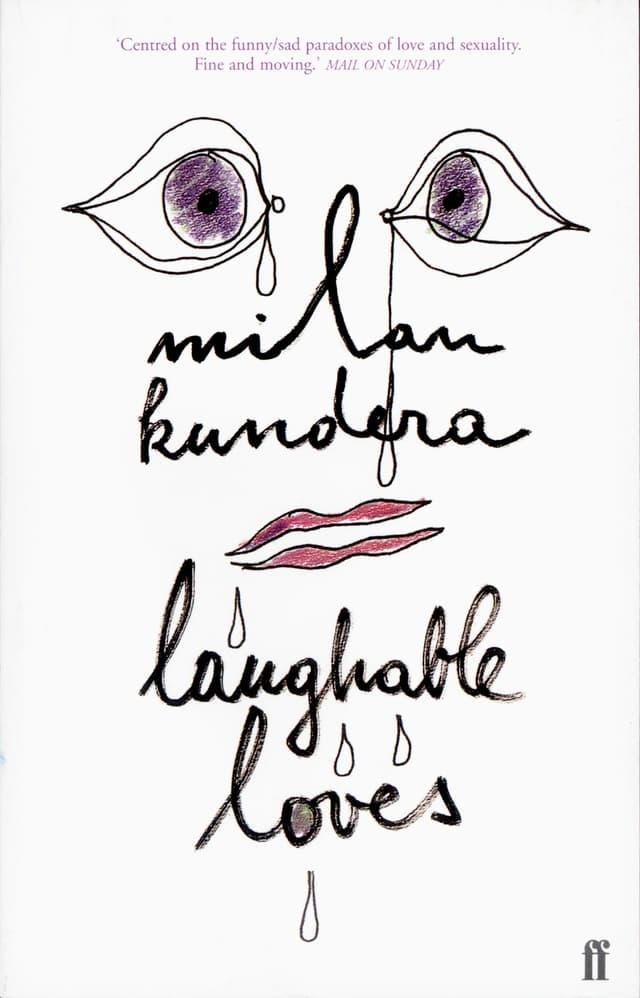
Book Review by Jeshu Adhikam
Where to begin if you'd want to try reading a new author? How to test the waters? One short yet concrete answer always remained "short stories". So, that's what I did too when I wanted to pick up some Milan Kundera, something lighter than his "Unbearable lightness of Being" and hence did I land on his stories, "Laughable Loves".
This is a collection of seven short stories, three of them being linked to each other like a continuum, but definitely not the most thrilling of the lot. That's not to say that I didn't like the book but to say that, to give them the bulk of it is not something I was appreciative of. Anyways, let me get to things I liked, things I loved before proceeding to things that didn't work for me.
If I had to gather a single overarching theme for these stories, it should be: games. Games, often being playful and silly at the start snowballing into something entirely unexpected that would leave you unsettled. In 'Nobody will laugh', you'll see a stubborn lecturer avoiding to write a review for a reason you'll either just laugh off at, or contemplate seriously but our narrator for one never takes the situation he finds himself in seriously. To me, this story stood out for its philosophy, unusual storyline, and tension. It was as gripping as a thriller, which can also be said and far more loudly in the case of 'The hitchhiking game' in which two young lovers start off a roleplay they were not really prepared for. This was psychological, with each and every thought of a character put out on paper, making it wholly immersive and leaving you with a feeling of being stuck. In 'The golden apple of eternal desire', two middle-aged men go out to find some company in a girl, never settling for one that would make you think if they had taken One Plus's business motto seriously. This story leaves a reader feeling pity for these men. And then there was 'Eduard and God', a power-packed story playing a game on faith this time.
And now, before moving on to the duller side of the stories, a general note on writing style. The moment I started reading this book, I couldn't help myself but think how accessible is it to adapt into a short film or a play or an anthology. The characters, setting, and dialogue had such clarity to them that it is impossible not to follow what was going on. And also, each short story is numbered into many sections, making it less tiresome. Textbook characters talking textbook dialogue, put in textbook situations. Textbook beginnings, textbook endings. It's that perfect. Plus sometimes, the narrator directly speaks to you, asking for your opinion on the proceedings. Each story had a singular vision, a single point to make and arrive at it. It's also worth mentioning that this was a work of translation and seemed there was nothing really lost in translation and had an original and natural flow to it.
Now, coming to stories I didn't particularly enjoy which were also painfully long were three sequential ones, one of them aptly named 'symposium'. This section had many characters, but none particularly striking. It was once again a game, well written with an untoward incident at its heart but nothing really saved the day for the set-up itself felt artificial. I mean, we here have a bunch of doctors on duty, talking endlessly of philosophy and philosophically, to the point where it feels forced. But, the two stories that continued, set in distant time from the current one were powerful. Especially, one called 'Let the old dead make room for the young dead.'
To sum it up, read this book if you'd want to read how it gets done. In this case, to know how to perfectly plot a story, write accurate dialogue and most importantly to drive a singular point really effectively.